Your Training Partner Might Be the Reason You're Not Growing
The Buddy System Has a PR Problem
Walk into any commercial gym in America and you'll see them everywhere — training pairs, lifting crews, the whole social ecosystem that gym culture has built around working out together. Instagram celebrates it. Fitness influencers preach it. "Find your accountability partner" has become one of the most repeated pieces of advice in the entire fitness space.
And look, there's a reason it sounds good. Accountability is real. Motivation is real. Having someone who shows up when you don't feel like it has genuine value, especially early in a lifting career.
But here's the part nobody's saying out loud: for a lot of serious lifters, the training partner dynamic has quietly become one of the biggest obstacles to actual muscle growth. Not because the other person is a bad influence, necessarily. But because the social structure of paired training is fundamentally at odds with what maximum hypertrophy actually requires.
Let's break down why — and be honest about when the tradeoffs are worth it.
The Ego Problem Nobody Admits To
This one's uncomfortable, so let's just say it: most training partnerships create subtle ego competition that distorts programming decisions.
You're supposed to be doing 185 on bench today based on your program. But your partner just loaded 205. So you load 205. That's not progressive overload — that's pride. And pride doesn't build muscle. It builds injury risk and ego-driven training decisions that prioritize what looks impressive over what actually produces results.
This happens constantly in training pairs, and it's almost never consciously acknowledged. The competition feels motivating in the moment. But over weeks and months, consistently loading more than your recovery can handle, or pushing past technical failure to keep up, creates a training environment that's optimized for performance on any given day rather than long-term structural progress.
The guys who build the most muscle aren't always the ones lifting the most weight. They're the ones executing the right stimulus with the right technique at the right time — and that requires making decisions based on their own body, not someone else's.
The Rest Period Reality
Here's something that gets almost no attention in the conversation about training partners: they wreck your rest periods.
Rest period length isn't arbitrary. For hypertrophy-focused training, research consistently points to 90 seconds to 3 minutes between sets as the sweet spot — long enough for meaningful phosphocreatine replenishment and performance maintenance, short enough to keep metabolic stress elevated. When you're training solo, hitting those windows is straightforward.
When you're training with a partner? Your rest period is however long it takes them to finish their set, adjust the weight, and get out of your way. Sometimes that's fine. Often it's 4-5 minutes. Occasionally it's interrupted entirely because they want to talk about what they're eating later.
Multiply that distortion across every working set in a session, and you've fundamentally changed the training stimulus — without changing a single exercise or rep count on paper.
The Intensity Problem Is Real
Some of the most productive sets you'll ever do are the ones that are genuinely uncomfortable — not just physically, but mentally. The kind of focus required to push into true hypertrophy-range effort, to stay connected to the muscle you're training rather than just moving weight from point A to point B, is a specific mental state.
It's also a fragile one.
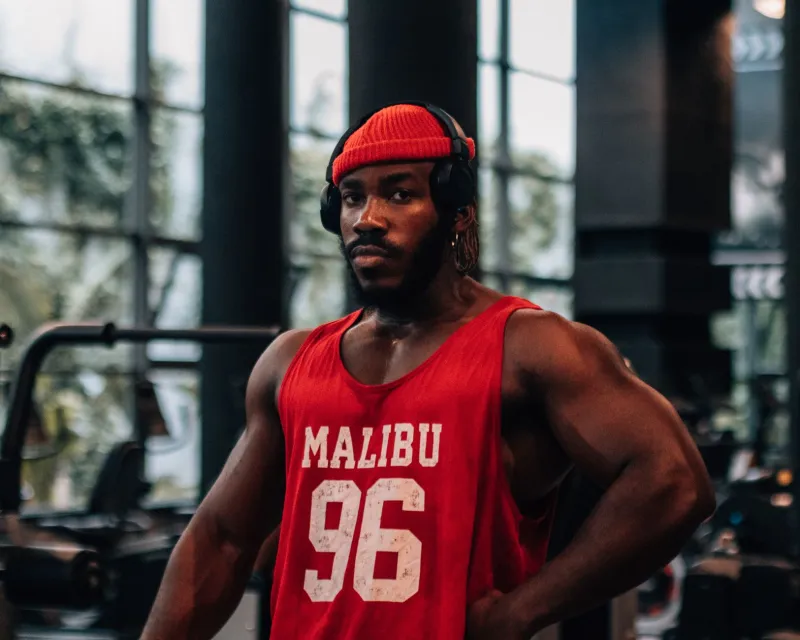
A comment between sets. A joke. Someone asking if you saw the game last night. These interruptions feel trivial, but they repeatedly break the psychological thread that high-quality training requires. The best sessions most solo lifters have are the ones where they're locked in — headphones on, internal focus high, genuinely present in every rep.
That state is almost impossible to maintain in a social training environment. And while the energetic buzz of training with someone can feel like intensity, it's usually just arousal — a different thing entirely.
When Training Partners Actually Help
This isn't an argument that training with others is always counterproductive. That would be too simple, and it wouldn't be true.
Training partners provide genuine value in specific contexts:
True spotting situations. Heavy barbell bench press, heavy squats — there are movements where a real, attentive spotter changes what you can safely attempt. If your partner is actually spotting (not just standing there giving you a 12-finger lift), that's a legitimate benefit.
Early-stage motivation and consistency. For newer lifters, showing up is the primary challenge. A training partner who helps solve the consistency problem is worth the training inefficiencies. The best training program you don't do beats the optimal program every time.
Structured competition for advanced lifters. If both partners are disciplined, experienced, and genuinely aligned on goals, the competitive element can push both people past self-imposed limits. But this requires a specific kind of partner — one who's as serious as you are, who respects programming decisions, and who understands the difference between motivating and enabling.
The key word in all of this is specific. The benefits of training with someone else are context-dependent. The costs are constant.
How to Build a Solo Training Practice That Actually Delivers
If you've been relying on a training partner for motivation and you want to transition toward more productive solo sessions, here's what actually works:
Create environmental accountability. Book your gym sessions in your calendar like appointments. Pay for a gym that has hours that align with your schedule so there's no excuse not to go. Remove the friction between you and the session.
Build a pre-training ritual. The reason training partners feel motivating is that they signal to your brain that it's time to work. You can create that same signal solo — a specific playlist, a pre-workout routine, even just the act of putting on your gym clothes at a consistent time. Rituals are powerful.
Track everything. Your training log is your accountability partner. When you can see that you hit 185 for 4x8 last week, you have a target. That target is more honest than any training partner because it doesn't care about your ego — it just tells you what you did and what you need to beat.
Use structured programs, not vibes. Solo training fails when there's no plan. With a training partner, the social energy carries you through ambiguity. Without one, you need a program that tells you exactly what to do so there's no decision fatigue, no wandering, no half-sessions.
The Bottom Line
Training with other people feels productive. It's social, it's energetic, and it creates the illusion of accountability. But illusion and reality aren't the same thing — and for a lot of intermediate and advanced lifters, the social structure of paired training is quietly capping their potential.
The most impressive physiques are usually built in focused solitude, with clear programming, honest tracking, and the kind of internal intensity that only happens when there's nobody around to perform for.
That doesn't mean never train with someone. It means being honest about what that dynamic is actually producing — and making sure your biggest muscle isn't your ego.