Your Arms Look Flat from the Side — And Here's Exactly Why
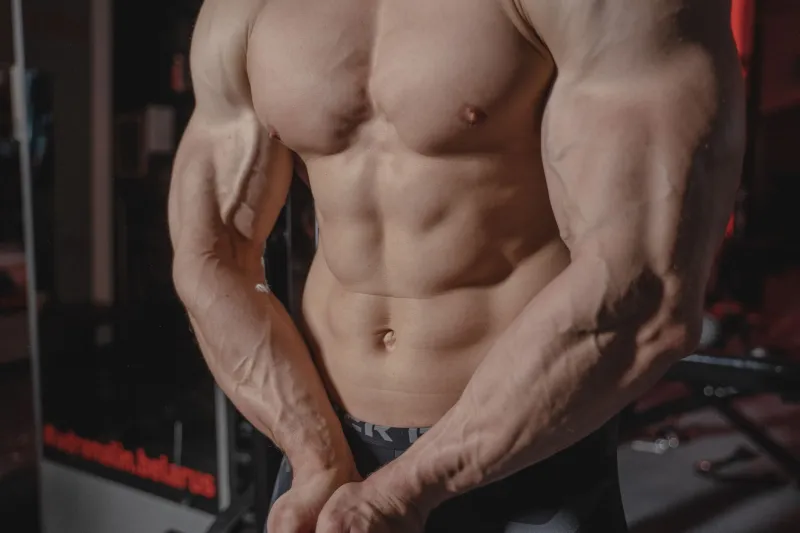
Picture this: you're at the gym, you hit a solid pump, you throw up a front double bicep in the locker room mirror, and things are looking pretty good. The peaks are there, or at least they're coming in. You feel solid.
Then someone snaps a photo of you from the side.
And suddenly those arms that looked impressive from the front look... kind of flat. Like two decent-sized tubes attached to your shoulders instead of the thick, dense slabs of muscle you thought you were building.
Here's the thing — you're not imagining it, and you're not alone. This is one of the most common blind spots in arm training, and it comes down to one core problem: almost every lifter optimizes exclusively for arm height and completely ignores arm thickness.
The Two Dimensions Nobody Talks About
When most guys think about building bigger arms, they're picturing the front double bicep. That classic pose. The one where your bicep peak shoots upward and your arm looks like it belongs on a magazine cover. That visual drives their entire training approach — more curls, more peak contraction, more work on the brachialis to push the bicep up higher.
And none of that is wrong, exactly. But it's massively incomplete.
Because a truly impressive arm — the kind that looks big from every angle — needs two things: height and thickness. Height is what you see from the front. Thickness is what you see from the side. And the muscles responsible for each are very different.
Front-facing arm size is largely driven by the bicep brachii, particularly the long head, which contributes to that coveted peak. Thickness — that dense, wide look from a side profile — comes primarily from the brachialis and the triceps long head, along with overall muscle density across the upper arm.
Most training programs hammer the bicep. They forget about the rest.
Why the Side Angle Exposes Everything
The side tricep pose is one of the most revealing angles in bodybuilding. It's not just a tricep shot — it's a full arm assessment. When you stand sideways and hit that position, judges (and cameras) are evaluating the total depth of your upper arm from front to back. Thin arms get exposed immediately.
For competitive bodybuilders, this is well understood. For everyday gym-goers chasing a bigger, more complete physique? It barely registers on the radar.
Think about the last time you deliberately trained for how your arms look from the side. Chances are, you haven't — because the side view isn't what stares back at you in the mirror every morning. Our gym culture is front-facing. Selfies are front-facing. Progress photos are almost always front-facing. So we train what we see, and we ignore what we don't.
The result? Arms that look decent head-on and kind of disappointing from every other angle.
The Brachialis: The Muscle That Adds Actual Width
If you want your arms to look thick from the side, the brachialis might be the single most important muscle you're under-training.
The brachialis sits underneath the bicep and, when developed, literally pushes the bicep up and outward. But more importantly for our purposes here, it adds significant depth and width to the upper arm. When someone has that full, dense look to their arms from a side angle, a big brachialis is almost always part of why.
The problem is that standard supinated curls (palms up) heavily favor the bicep. To really load the brachialis, you need to change your hand position.
Hammer curls are the most accessible option — neutral grip, thumbs up, elbows tucked. These shift a significant chunk of the work onto the brachialis and brachioradialis, building that thick, column-like look through the upper arm.
Reverse curls (overhand grip) take it even further. They're humbling — you'll use a lot less weight — but they're one of the best tools for building the kind of arm depth that shows up from the side.
Cross-body hammer curls are another underrated move. Curling across your body toward the opposite shoulder emphasizes the brachialis through a slightly different line of pull, adding variety without overcomplicating your routine.
If you're not doing at least one of these consistently, you're leaving real arm development on the table.
The Tricep Long Head: Half Your Arm Is Hiding
Here's a number that should change how you train: your triceps make up roughly two-thirds of your upper arm mass. Two-thirds. Yet most guys spend the majority of their arm training on biceps.
And within the triceps, the long head is the biggest and most visible from the side. It's the portion that hangs down and creates that full, horseshoe look when the arm is extended — but it also adds serious thickness to the back of the arm that reads as overall arm size from a side profile.
The long head is the only tricep head that crosses the shoulder joint, which means it's most fully stretched — and most effectively trained — when your arms are overhead. Standard pushdowns and bench dips don't get you there.
To actually target the long head, you need overhead tricep work: overhead cable extensions, overhead dumbbell extensions (skull crushers done behind the head rather than to the forehead), or even incline close-grip pressing where the arm travels through a longer range. These movements stretch the long head under load, which is where the real growth stimulus happens.
If your current tricep training is mostly pushdowns and dips, your side profile is probably paying the price.
How to Actually Fix It: A Practical Approach
You don't need to overhaul your entire program. You need to audit it.
Start by taking a side photo of your arms — both flexed and relaxed. Be honest with yourself. Do they look as thick and full as they do from the front? If the answer is no, here's a simple rebalancing approach:
1. Add one brachialis-focused movement per arm session. Hammer curls, reverse curls, or cross-body curls. Pick one, do 3-4 sets, and do it consistently for 8-12 weeks before judging results.
2. Replace at least one standard pushdown with overhead tricep work. Overhead cable extensions or dumbbell overhead extensions done with a full stretch at the top. Prioritize the stretch over the weight.
3. Check your exercise order. If you're doing pushdowns as your primary tricep movement and adding overhead work as an afterthought at the end, flip it. Hit the long head when you're fresh.
4. Start assessing from multiple angles. Your side profile should become a regular part of how you track progress. If you only check the front, you'll only train for the front.
The Takeaway
Bigger arms aren't just about a better bicep peak. They're about building a complete upper arm that looks impressive from every angle — front, back, and side. The lifters who figure this out early are the ones who end up with arms that genuinely turn heads, not just arms that photograph well in one specific pose.
Train the brachialis. Train the tricep long head. Stop letting half your arm development go to waste because you never bothered to check what you look like from the side.
Build bigger. Train smarter. Cover every angle.