Your Arms Are Bigger Than You Think — You're Just Building the Wrong Part
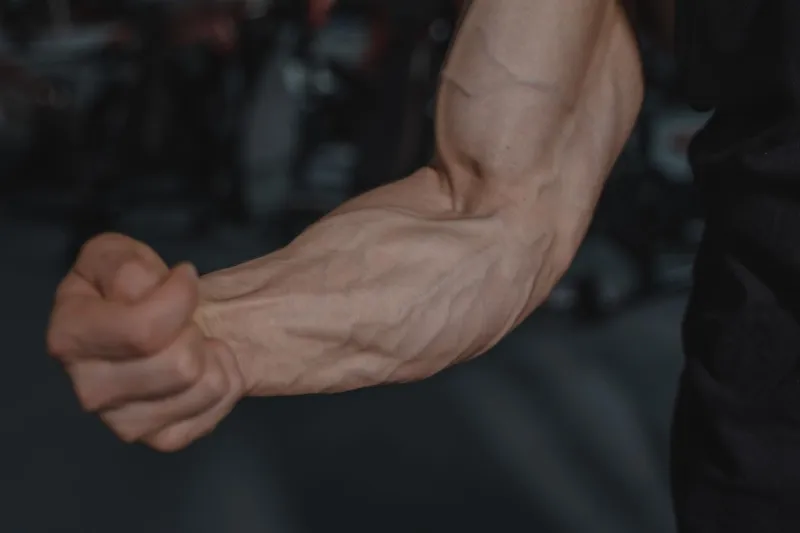
Every guy who's ever flexed in a locker room mirror has had the same thought: why don't my arms look as big as they measure? You've been curling for years, you've got 16 inches on the tape, and yet something still looks... flat. Underwhelming. Like the arm you see in your head and the arm you see in the mirror are two completely different limbs.
Here's the hard truth: you're probably chasing the wrong thing entirely.
The obsession with bicep peak — that sharp, mountain-top split you see on stage at the Olympia — has sent millions of lifters down a rabbit hole that leads nowhere productive. And if you've been programming your arm days around "peak-building" exercises, you've been leaving serious size on the table.
What Peak Actually Is (And Why You Can't Train Into It)
Let's get anatomical for a second, because this matters. Bicep peak is largely determined by your muscle's insertion point — specifically, how high or low the bicep muscle belly sits relative to your elbow joint. Lifters with a high bicep insertion have a shorter muscle belly, which creates that dramatic peak when flexed. Guys with a low insertion have a longer, flatter bicep that looks fuller at rest but doesn't stack up the same way when they hit a front double bicep.
You inherited your insertion point. No amount of concentration curls is going to change that.
What you can change is the overall mass, thickness, and width of your upper arm — and that's where most lifters are completely leaving gains on the table.
The Muscle Nobody Talks About Enough
Slide underneath the bicep and you'll find the brachialis — a flat, wide muscle that sits between your bicep and tricep. It doesn't get the Instagram attention, it doesn't show up in most arm-day programs, and most people couldn't pick it out in an anatomy diagram. But if you want arms that look thick and powerful from every angle, the brachialis might be the most important muscle you're under-training.
Here's why: the brachialis actually sits beneath the bicep. When you develop it, it physically pushes the bicep upward. That's right — you can create the appearance of a higher peak not by training your peak, but by building the muscle underneath it. It's the bodybuilding equivalent of raising the stage.
Brachialis responds best to hammer curls and reverse curls — movements where your wrist is in a neutral or pronated position, taking the bicep out of its most mechanically advantageous position and forcing the brachialis to do more of the work. If your arm program doesn't include at least one of these movements performed with genuine intention and progressive overload, you're skipping the foundation.
The Two-Thirds Problem Nobody Wants to Admit
Here's something that should be obvious but somehow gets ignored constantly: your triceps make up roughly two-thirds of your upper arm mass. Two-thirds. And yet arm day is almost universally treated as bicep day with a few half-hearted pushdowns tacked on at the end when you're already gassed.
If you want bigger arms — not just a more peaked bicep, but genuinely larger arms that fill out a t-shirt — tricep development is non-negotiable. The long head of the tricep in particular runs all the way up into the shoulder, and when developed properly, it creates that horseshoe shape that makes arms look thick even when they're hanging at your side.
Close-grip bench press, overhead tricep extensions, and skull crushers should carry just as much weight in your programming as your curl variations. If you're spending 20 minutes on biceps and 10 minutes on triceps, you're building a structurally imbalanced arm and wondering why the tape measure doesn't match the mirror.
Muscle Maturity vs. Muscle Size
There's another factor that doesn't get nearly enough discussion in the average gym conversation: muscle maturity. A bicep that's been trained consistently for five or six years looks fundamentally different from one that's been trained for two — even if the measurements are similar.
Mature muscle tissue is denser. It has more developed striations, better separation, and a harder, more defined appearance under the skin. It fills in at the edges. It shows detail that newer muscle doesn't have yet. This is why experienced bodybuilders can look bigger in a t-shirt than their actual measurements would suggest, while newer lifters with the same tape measurement look comparatively soft.
You can't rush maturity. But you can stop wasting the time you have by chasing peak height instead of building genuine mass across the entire arm.
The Arm Day Overhaul You Actually Need
So what does a smarter arm program actually look like? A few principles worth locking in:
Lead with compound movements. If you're doing arms as a standalone day, open with close-grip bench or weighted dips before you ever touch a curl. You'll hit the triceps with more intensity when you're fresh, and you'll build the structural foundation that makes everything else look better.
Rotate your curl angles. Incline dumbbell curls stretch the long head of the bicep. Preacher curls isolate the short head. Standing curls recruit more of the full muscle. Varying these throughout your training cycle ensures you're developing the whole muscle, not just the part that fires hardest in your go-to movement.
Make hammer curls mandatory. Not optional, not occasionally — every single arm training cycle. Heavy, controlled hammer curls are the single best investment you can make in brachialis development, and they're one of the most underloaded exercises in most people's programs.
Treat tricep training like it matters. Because it does. The overhead position — arms fully extended above your head — puts the long head of the tricep in its most stretched position and drives the most growth. Don't skip it.
Stop Measuring, Start Looking
The tape measure is useful, but it's not the whole story. A 16-inch arm with developed brachialis, mature muscle tissue, and thick triceps will look significantly larger than a 16.5-inch arm that's all bicep and no depth. Visual size is a combination of mass, density, proportion, and development — not just circumference.
The guys with genuinely impressive arms aren't the ones who found the perfect peak-building exercise. They're the ones who spent years building every part of the upper arm with consistency and intelligence — and stopped trying to train around their genetics instead of working with them.
Your peak is what it is. Your total arm size? That's entirely on you.